


There is a smell I still associate with the burn ward of the hospital where my mother worked. I was too young to be left alone at home, so I often went with her, carrying my drawing books and finding people to talk and play with while she worked. She spent more than three decades as a nurse in public hospitals in India, many of them in that burn ward.
That smell was unmistakable, and strong enough that most people instinctively wanted to move past that corridor quickly. I remember it alongside drawing books, long afternoons, and the extra tiffin my mother sometimes carried with her to work. Food to share with patients who had been there for weeks, sometimes months. She never made a point of it.
Years later, I studied pharmacy and returned to healthcare from a very different direction: commercial roles and field sales. Over seven years, I worked with more than 1,000 healthcare professionals across over 15 medical specialties. In some hospitals, I would find 60 or 70 representatives waiting outside the room of a senior doctor, all hoping for perhaps two minutes of attention. Often, I was the only woman there, a short young woman standing in a corridor full of men who had been doing this far longer than I had. In the beginning, those rooms could overwhelm me. With time, I learned to prepare enough that those rooms stopped feeling so intimidating.

Field sales also changes your relationship with rejection. You hear no frequently enough that, over time, it stops carrying the same drama. A bad interaction can still disappoint you, but it does not have to decide what happens the next morning. There is another hospital, another conversation, another opportunity to begin again. I did not realise it then, but years of doing that made discomfort feel less like an emergency.
I learned quickly that no single approach worked with everyone. The same presentation, the same argument and, sometimes, the same version of me could not work everywhere. Doctors working in different specialties faced different realities, but even within the same market, no two people made decisions in exactly the same way. I began to notice that some of the strongest salespeople were not the loudest. They listened more than they spoke.
Over time, I became less interested in communicating everything I knew and more interested in understanding what mattered to the person sitting across from me. When people felt heard, they would tell you where the neat logic of an Excel sheet or a presentation began to fall apart in the reality of their clinic. That ground-level view stayed with me when I later tried to build my own healthcare ventures. I could see opportunities, build relationships and create momentum, but entrepreneurship exposed a limitation that sales had not. Believing deeply in an idea does not mean you know how to build an organisation around it. I had people around me and plenty of energy, yet I struggled to create a team with sufficiently complementary skills, shared commitment and the ability to stay together when the road became uncertain. Looking back, I could generate movement, but I had not yet learned how to build something that could carry that movement beyond me. I understood some of this only much later, at IMD.
I arrived at IMD on the BackPack Excellence Scholarship, with the rare privilege of giving an entire year to learning. I wanted to use that year fully, not spend it protecting the person I already knew how to be. IMD makes that difficult anyway!
The year has a way of repeatedly putting you in rooms where what worked before no longer works quite as neatly. People from different industries, nationalities, personalities and ways of thinking are brought together, often with little time, imperfect information and plenty of pressure. I came from science, so subjects such as finance and accounting were new and demanding. Yet some of the harder learning had little to do with formulas.
At one point, a group I was working with suggested that I take on the presentation, partly because they thought it might be useful for me to try something outside my comfort zone. I found the suggestion interesting.
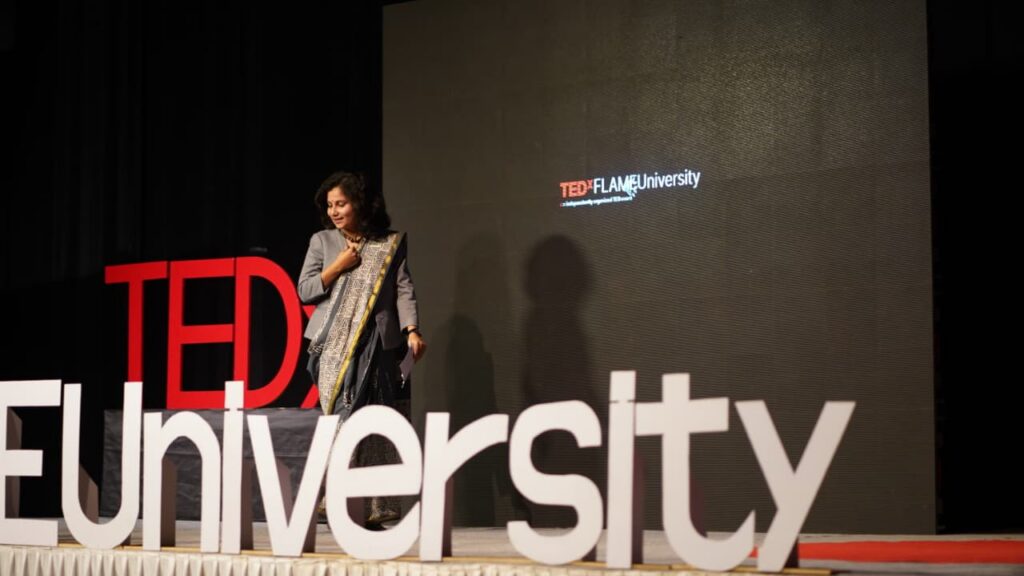
As a child, I was shy and sometimes stammered. I built my confidence in public speaking slowly, by putting myself on stages again and again. Over the years, I went on to speak at national events, host programmes, and mentor more than 200 students from low-income schools through some of the same fears I had once known. None of that history was visible to people who had only recently met me. They were reading me from the moments we had shared so far, just as I was reading them from theirs. It made me think about how quickly we build versions of other people in our minds.
That gap between intention and perception becomes even more interesting across cultures. Directness can feel efficient to one person and abrasive to another. Silence may appear thoughtful, disengaged or uncertain depending on who is interpreting it. Confidence, humour, disagreement and even friendliness travel differently. I began to understand that I could not, and should not, become a different person for every room. But I could become more aware of what another person might be seeing, and less likely to take every interpretation personally.
That has been one of the more demanding parts of the year. It is relatively easy to analyse people dynamics when you are standing outside them. It is much harder when you are tired, under pressure, convinced that your view is right and very much part of the situation yourself.
That is also why I have come to think differently about what an MBA is for. Frameworks, Finance, Strategy matters. But increasingly, machines can help us learn and apply much of that knowledge. What has been harder to automate is the experience of sitting in ambiguity with other people, knowing there may be no perfect answer, and discovering what happens to your own judgment, patience and behaviour when the conditions are not comfortable.
Much of this year has meant moving before the whole picture is visible, then looking back closely enough to see what I might have missed. That matters because the industry I know best is changing under my feet. I have seen healthcare as the daughter of a nurse, as a pharmacy student, from hospital corridors and corporate offices, through entrepreneurship, and now from a business-school classroom in Switzerland. Each step has widened the view. What feels clear to me now is that the healthcare industry I entered will not be the one in which I eventually make decisions.

Years from now, I may be making commercial decisions that affect patients I will never meet. By then, I hope I will have learned to step far enough back to understand markets, organisations and systems without stepping so far away that the people inside them disappear. I hope I will still remember what the field taught me about listening, how different reality can look from a hospital corridor, and how easily a strategy can become detached from the person who ultimately has to live with its consequences.
And perhaps that is why I keep returning to the extra tiffin.
My mother never described what she was doing as leadership. I doubt she thought about it in those terms at all. Burn patients often stayed for weeks or months, with family visits limited because of infection risk, so the ward became much of their world. The extra food, conversations and small routines gave them reasons to connect, help one another and feel less alone through a painful recovery. Today, hospitals would place much of this under patient experience and the patient journey, studying how the environment around care can influence recovery and even length of stay. She had none of that language. She saw a need, acted on it, and others began doing the same.
Perhaps that is the part I understand differently now. Leadership, at its most human, does not always come from the person speaking the loudest or holding the clearest authority. Sometimes it begins when someone notices what others have missed, chooses to act, and in doing so changes what the people around them begin to do.
One day, I hope the decisions I make can travel even further than that extra tiffin ever did, while carrying something of the same care with them.
Pooja Mungi is part of our 2026 MBA class.
Considering your own MBA? Find out if IMD is the right fit. Learn more →
