


Six weeks into their MBA, four IMD students boarded a plane to Barcelona to compete in the inaugural IESE Search Fund Competition against teams who had been in their programs for up to a year longer. Some competing students had even stayed on after finishing their degree specifically to take part.
The IMD team arrived in Lausanne on January 13 and spent their first weeks in leadership development sessions, career workshops, and strategic decision-making exercises. Economics, finance, and accounting classes had only just begun.
The other five schools competing, IESE, INSEAD, HEC Paris, London Business School, and ESADE, had been in their MBA programs far longer. IESE, which has built the largest search fund research and practitioner network outside North America, had run an internal competition with ten to twelve teams before selecting the one that would represent them.
Our IMD team did not only perform well, but they tied for first place with the IESE team.
The team
The four IMD students who competed had no formal training in search funds. What they brought instead were four careers’ worth of directly relevant experience.
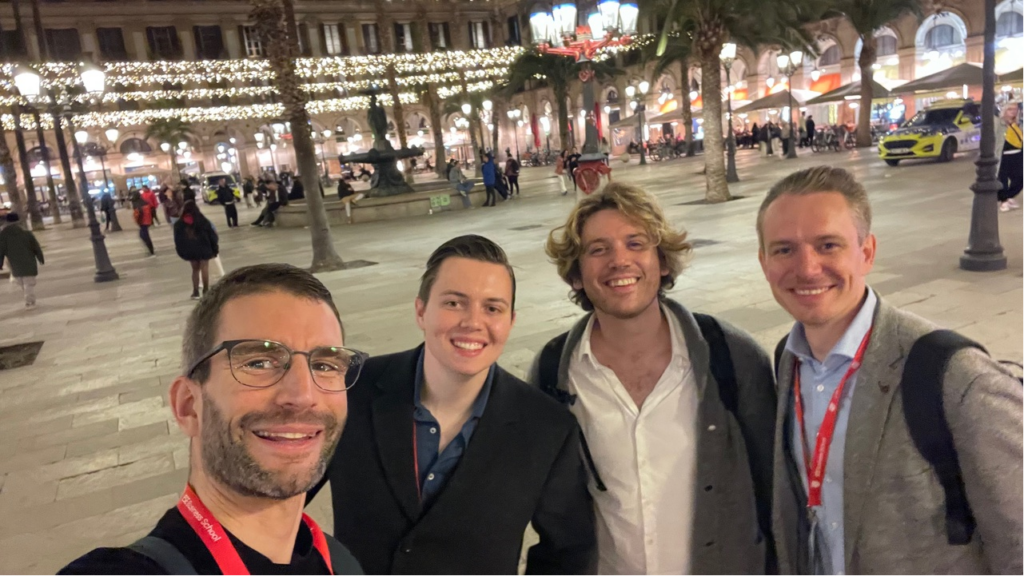
Michele Gaeta, Jaeger Dochtermann, James Crissy, Kevin Marty in Barcelona
Kevin Marty is an engineer who spent three years in corporate before acquiring a stake in a company and spending the following three years building it in Switzerland. The business was precisely the kind of asset that makes an ideal search fund target: stable cash flows, a defined customer base, genuine room to grow. He came to IMD ready to operate on a larger stage. “I wanted to get back to an international stage,” he says, “and be surrounded with very talented people from different backgrounds and industries. The business I had was super niche, super local. I thought there was more potential for something bigger out there.”
Michele Gaeta has been an entrepreneur for eleven years across two industries and two countries. In Italy, he built a bicycle wheel brand from scratch, drawing on years of experience as a professional cyclist, then acquired a competitor to expand his product range and distribution network before selling his stake. He then identified an opening in the artisan gelato market in Iceland, sourced a technical partner from Italy, deployed his exit capital, scaled to four stores and a B2B factory supplying restaurants and supermarkets, survived a complete shutdown during COVID at the peak of his investment cycle, and sold four and a half years later at a 20x return on invested capital. “I had a few mergers and acquisition experiences in my real life,” he says. “And I kind of lived them again during the search fund process.”
James Crissy studied finance and entrepreneurship in Paris, then worked across venture-backed companies and his own startups, gaining direct experience on both sides of the fundraising table. As an American, he was already more familiar with search funds than his European counterparts, where the model has historically been concentrated within specific business school circles. He came to IMD to build a network in a new geography and to be surrounded by people thinking at a larger scale. “Being around people who are so diverse in their experiences is really valuable for growth,” he says. “In smaller startups, you’re surrounded by great people, but the scope of what they’re thinking about can be narrower.”
Jaeger Dochtermann spent a year and a half in Boston doing commercial due diligence for a private equity-focused boutique, analyzing acquisition opportunities. He then moved to Switzerland to join Roland Berger, where he worked primarily in Germany and France across operational improvement, restructuring, growth strategy, and M&A functions including carve-outs and post-merger integration. He came to IMD to move beyond consulting and find what comes next.
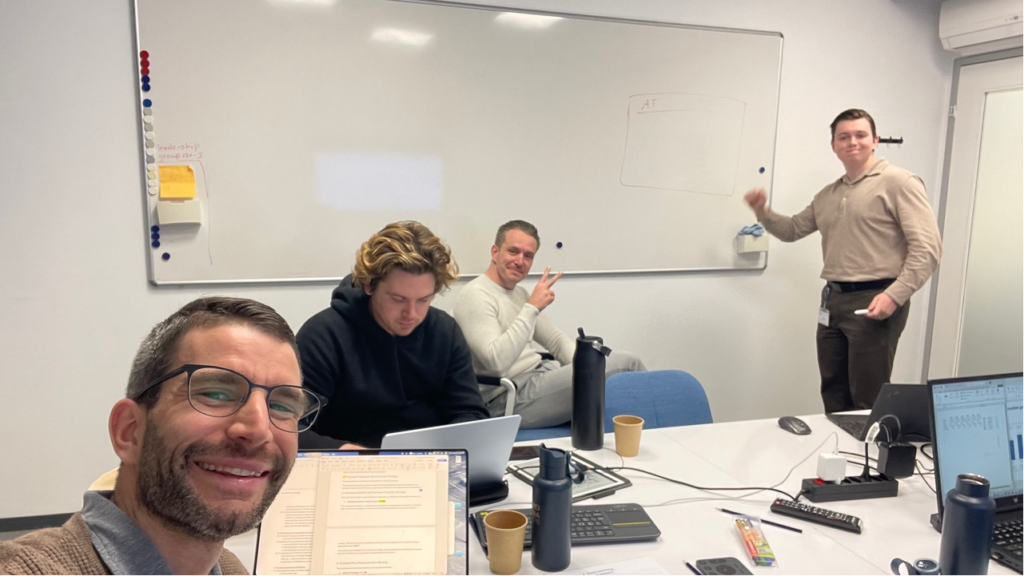
The four linked up informally during the first weeks of the program, without any structured process. Jaeger describes what they found when they looked at what they had collectively: “IMD’s diversity is our strength. We had all these different backgrounds, and we didn’t get truncated by just the curriculum. We each had our own unique approaches.” Michele puts the practical version of that: “Each one of us had some skill more advanced than what you’d get from a general MBA course. We could leverage those skills.” Together they covered almost every dimension the competition would test: entrepreneurial operating experience from people who had bought, run, and sold companies; deep financial and M&A analytical knowledge; fundraising instinct from both sides of the table; and negotiation skills built in real transactions, not simulations.
What a search fund is
Search funds originated in the mid-1980s at Harvard Business School and Stanford Graduate School of Business and were brought into the international arena largely through IESE. As Jaeger puts it: “It was an American invention at Stanford, and it came over here with Jan Simon, who was one of the judges.” Professor Jan Simon is the Academic Director of IESE’s International Search Fund Center and Managing Partner of Vonzeo Capital Partners and is widely credited with establishing IESE as the institutional home of search funds outside North America, a role that has produced over 60 IESE alumni-led search funds across 20 countries.
The model works as follows: a searcher raises capital from investors, uses it to identify and acquire a small-to-mid-sized business, typically one with $1m–$5m in EBITDA and revenues in the range of $10m–$30m, then installs themselves as CEO and operates the company for five to six years before exiting. The ideal acquisition target is a well-run, profitable business where the founder is ready to leave and there is no clear succession plan. As Jaeger describes it: “You’re taking over a company and being the one running it like an entrepreneur would, without the startup phase.” You take on debt to buy it, pay it down, grow the business, and exit with equity upside.
The model sits below the threshold of traditional private equity, which targets larger businesses. The retirement wave moving through Europe’s owner-managed companies, founders in their sixties with no family members lined up to take over, has made the pipeline of potential acquisition targets considerably larger. For family offices in particular, search funds offer exposure to private equity-style returns at smaller ticket sizes and over longer investment horizons. Switzerland, with its concentration of family offices and legacy SMEs, is arguably the most obvious European market yet to fully develop its search fund ecosystem.
The competition
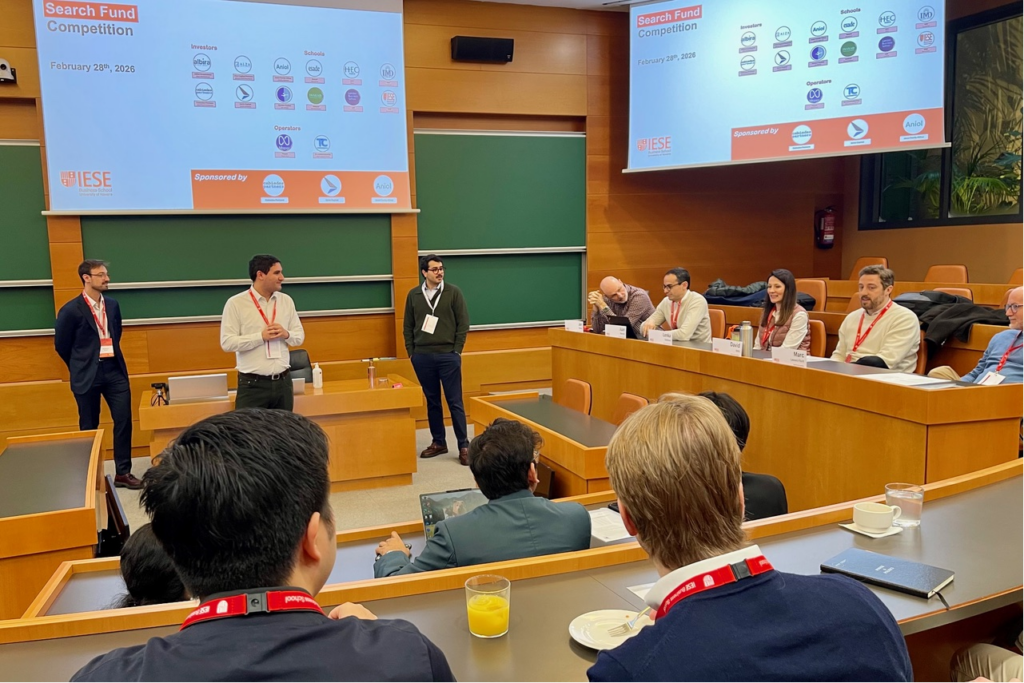
The IESE Search Fund Competition was designed to replicate, as closely as possible, what a real searcher goes through. A week before arriving in Barcelona, teams received detailed financial and operational information on two real companies that had already changed hands. They analyzed the businesses, built valuations, and prepared due diligence questions. When they arrived in Barcelona, the first order of business was sitting down with the former owners, who were also acting as judges, for live diligence interviews. Based on what they learned, teams revised their valuations, then entered into a negotiation to get one of the companies under a letter of intent, agreeing on a price and payment terms. They then rebuilt their entire investment presentation and pitched it to a panel of active search fund investors, including Albira Investments, Alza Capital Partners, Aniol Family Office, Cabiedes and Partners, Istria Capital, and Vonzeo Capital, to raise the capital needed to fund the transaction they had just negotiated.
The day in Barcelona compressed live diligence, financial modeling, negotiation, and investor pitching into a single sequence with almost no room for error.
What was the key to their success?
When it came to the actual mechanics of the day, Michele and Kevin had both sat across the table from real sellers in real negotiations before. Jaeger had spent years professionally building exactly the kind of financial analysis the competition required. James had been through investor pitches from both directions. When the moment came to negotiate a letter of intent with a former company owner or stand up in front of active investors and argue an acquisition thesis, none of them were doing something entirely unfamiliar.
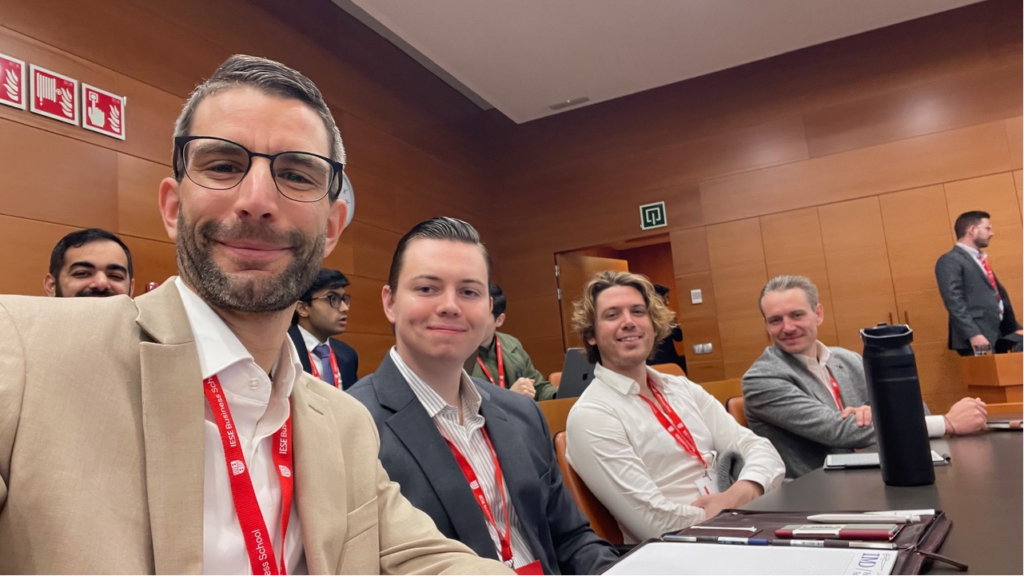
Experience alone does not explain the result. From its first weeks, IMD’s program places strong emphasis on communicating under pressure: structuring an argument, telling a clear story, and making a case to an audience that has not yet had time to develop trust in you. That became clear in Barcelona. “You can have the best data,” James notes, “but if you can’t go up there and present it convincingly, it’s not going to be nearly as impactful. That’s somewhere we stood out.” By the team’s own account, Jaeger’s slides were exceptional, and each of the four was able to stand up and deliver their part of the argument with the kind of clarity that comes from having been pushed to communicate well from day one of the program.
There is also something in how the team itself functioned, which Jaeger credits directly to IMD. “We learned so much from each other, both on the personal level and on the technical skills.” James is more specific: “We didn’t have any major conflicts. We had different, complementary skills, so there was no butting heads over entrenched ways of doing things. It was an honest and smooth process.” Kevin draws the broader point: “It’s not about what classes you’ve taken or how much you’ve studied for it. It’s really the team thing that differentiates, and that’s a learning I’ll take forward.”
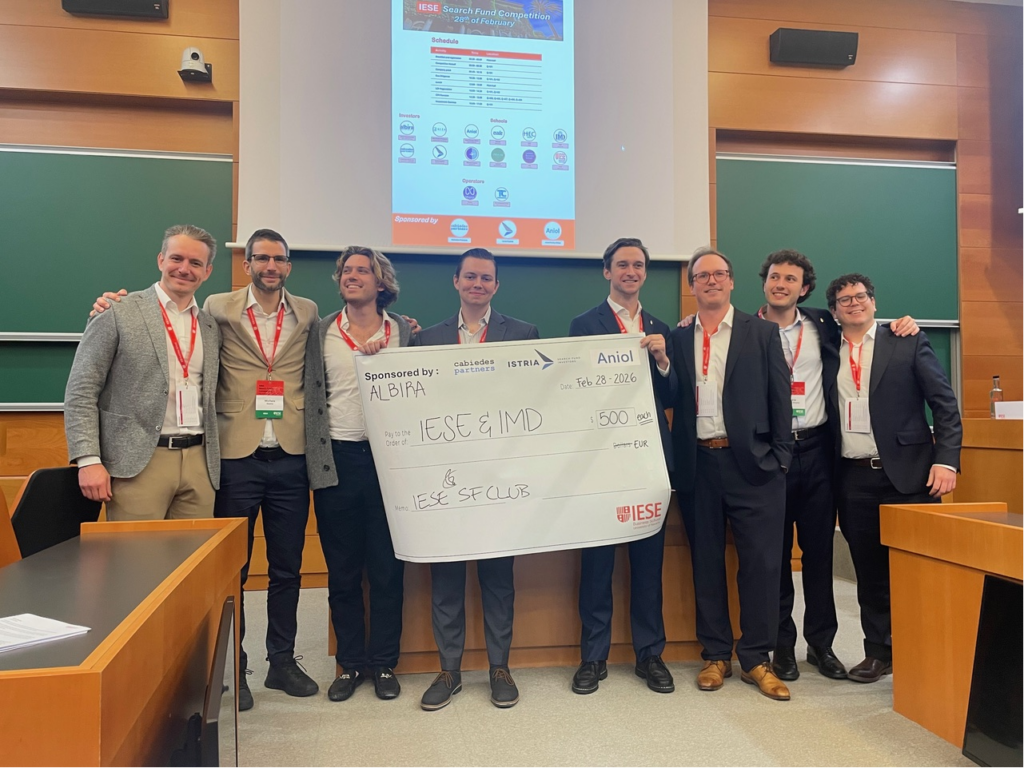
Winning the competition opened something up for all four of them, and the conversations they have been having since returning to Lausanne are less about the result and more about what it pointed toward.
Search funds map unusually well onto the IMD cohort. The model is most effectively executed in the searcher’s home market, where they understand the language, the culture, the management dynamics, and how sellers think. IMD’s MBA class draws from more than 30 nationalities in a cohort of roughly 90 students, which means it contains people who could deploy the search fund model across a wide range of geographies from a shared base in Switzerland.
There is also a natural overlap with two of IMD’s most distinctive networks. The Family Business Network connects multi-generational family-owned enterprises globally, and the Family Office Network brings together private wealth managers and investors. Both are natural constituencies for search funds: family businesses are the most common acquisition targets, and family offices, which manage private wealth over long time horizons rather than fund cycles, are well-suited as the patient capital behind a search fund deal. “For family offices especially, this is the new stage of private equity,” Jaeger says. “Private equity was how a lot of these people made money. But for family offices that do not reach the scale necessary for traditional PE, this is a good way for them to deploy capital and diversify.”
What comes next
Switzerland itself is still early in developing its search fund ecosystem relative to Spain, despite having many of the structural conditions that make the model work well. The four are now discussing how to bring that knowledge into IMD more formally, connecting it to the school’s family business and investor networks and making the tools and frameworks accessible to the wider cohort. As Jaeger puts it: “There’s an urgency to drive this topic at IMD, and understand how this opportunity can be best utilized?”
Part of what makes the IMD cohort such a natural fit for search funds as a post-MBA path is something Jaeger flags directly: “Because of how a search fund functions, you will be strongest in your home country, where you know the language and how to manage your people.” In a cohort of more than 30 nationalities, that means the knowledge and appetite to pursue this model across a wide range of markets is already concentrated in one building in Lausanne.
As James sees it, that is exactly the point. “Being around people so diverse in their experiences is really valuable,” he says. The goal now is to make sure more IMD students leave knowing that search funds are a real path available to them.
Considering your own MBA? Find out if IMD is the right fit. Learn more →
